

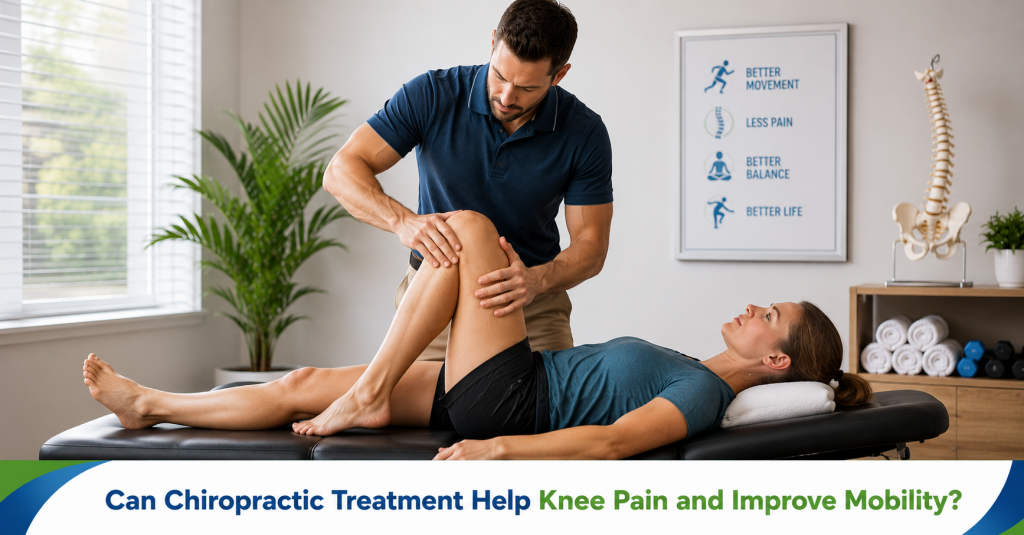
When people think of chiropractic care, they usually think of the spine, not the knee. So it’s a fair question: can chiropractic treatment for knee pain actually help, or is that outside a chiropractor’s wheelhouse? At Meade Chiropractic, this comes up more often than you’d expect, and the answer is yes, for a lot of knee pain, chiropractic care can make a real difference.
The connection isn’t always obvious, but your knee doesn’t work in isolation. It’s part of a chain that runs from your foot all the way up through your hip and spine, and misalignments anywhere along that chain can directly affect how your knee moves and feels. Let’s break down how this works.
The Surprising Link Between Chiropractic Care and Knee Pain
Your knee is a hinge joint, but it relies heavily on the alignment and function of the joints above and below it. If your hips are misaligned, your pelvis is rotated, or your gait has shifted due to compensation somewhere else in your body, your knee often ends up absorbing stress it wasn’t designed to handle. That’s where chiropractic treatment for knee pain comes in, not by ignoring the spine, but by looking at the whole movement chain the knee is part of.
How Chiropractic Treatment Helps Knee Pain and Mobility
Extremity Adjustments for the Knee Joint
Many people don’t realize that chiropractic care extends beyond the spine. Through manipulation of the spine and extremities, a chiropractor can directly address restrictions in the knee joint itself, improving mobility and reducing the compensation patterns that come from a joint that isn’t moving properly.
Correcting Hip and Pelvic Alignment
A misaligned pelvis changes the angle at which your leg meets the ground, which shifts pressure through your knee with every step. Correcting this alignment often reduces the uneven strain contributing to knee discomfort.
Improving Gait and Movement Mechanics
When something in your spine, hip, or ankle isn’t functioning correctly, your body naturally adjusts how you walk to compensate. Over time, this altered gait puts extra stress on the knee. Chiropractic care helps identify and correct these compensation patterns at their source.
Addressing Muscle Imbalances Around the Knee
Tight or weak muscles in the hips, thighs, or calves can pull the kneecap out of its ideal tracking position, contributing to pain during movement. Chiropractic care, often combined with targeted stretching and strengthening guidance, helps restore better balance around the joint.
Common Causes of Knee Pain Chiropractic Care Can Address
- Referred pain from the lower back or hip, where the actual source of discomfort isn’t the knee itself
- IT band syndrome, caused by tightness along the outer thigh that pulls on the knee
- Patellar tracking issues, where the kneecap doesn’t move smoothly within its groove
- Overuse and repetitive strain, common in runners, walkers, and physically active individuals
- Post-injury stiffness, where scar tissue or compensation patterns limit full mobility even after healing
- Mechanical stiffness related to arthritis, where improving joint mobility can reduce discomfort
Is Chiropractic Care Right for All Types of Knee Pain?
Not every knee issue is a good fit for chiropractic treatment alone. Acute fractures, complete ligament tears, or significant structural damage typically require orthopedic evaluation and, in some cases, surgical intervention. Chiropractic care tends to be most effective for mechanical, alignment-related, and overuse-based knee pain, the kind that develops gradually or stems from compensation elsewhere in the body, rather than sudden traumatic injury. A proper evaluation can help determine which category your knee pain falls into.
Common Mistakes People Make When Dealing With Knee Pain
- Only focusing on the knee itself. Ice and rest won’t resolve knee pain that’s actually coming from hip or pelvic misalignment.
- Ignoring hip and ankle mobility. Restrictions above or below the knee often force it to compensate, worsening the underlying issue.
- Pushing through pain during activity. Continuing to run or exercise on a mechanically compromised knee can deepen the compensation pattern.
- Assuming all knee pain requires surgery. Many cases of mechanical knee pain respond well to conservative, non-invasive care.
- Skipping a full-body evaluation. Treating the knee without checking the spine, hips, and gait often misses the actual root cause.
Practical Tips to Support Knee Mobility and Recovery
Strengthen Supporting Muscles
Strong hip, thigh, and calf muscles help stabilize the knee and reduce the load it has to absorb on its own during movement.
Improve Hip and Ankle Mobility
Since the knee relies on proper movement above and below it, stretching and mobility work for the hips and ankles can directly reduce knee strain.
Avoid Prolonged Sitting or Standing
Extended time in one position can stiffen the muscles and joints surrounding the knee. Regular movement breaks help maintain flexibility.
Warm Up Properly Before Activity
Cold, stiff muscles and joints are more prone to strain. A proper warm-up prepares the knee and surrounding structures for movement.
What to Expect From Chiropractic Treatment for Knee Pain
Treatment typically begins with an evaluation of not just the knee, but your hips, spine, and overall gait, since the real source of knee pain often lies elsewhere. From there, a chiropractor can use targeted adjustments, including extremity manipulation, alongside guidance on strengthening and mobility work to address both the knee itself and the underlying movement pattern contributing to it.
Serving Anderson Township, Fort Thomas, Newport & Taylor Mill
Dr. Brandon Meade provides chiropractic treatment for knee pain and mobility to patients throughout Fort Thomas, Newport, and Taylor Mill, KY, as well as Anderson Township, OH, and the broader Hamilton County area, helping active individuals get back to moving without the compensation patterns that quietly wear down the knee over time.
Frequently Asked Questions
Can a chiropractor actually help with knee pain, or just back pain?
Yes. Chiropractic care extends beyond the spine to include extremity adjustments, which can directly address knee joint restrictions and the hip or gait issues often contributing to knee pain.
How does hip misalignment cause knee pain?
A misaligned hip or pelvis changes the angle your leg meets the ground, placing uneven stress on the knee with every step, which can lead to gradual pain and dysfunction over time.
Is chiropractic treatment for knee pain a good alternative to knee surgery?
For mechanical or alignment-related knee pain, yes, it can be an effective non-surgical option. For significant structural damage, surgery may still be necessary, and a proper evaluation can clarify which applies to you.
Can chiropractic care improve mobility for runners with knee pain?
Yes. Runners often experience knee pain from gait compensation or muscle imbalance, both of which chiropractic care and targeted mobility work can help address.
How long does it take to see improvement in knee mobility with chiropractic care?
This varies by individual, but many patients notice improved mobility and reduced discomfort within several weeks of consistent care.
Does chiropractic care help with arthritis-related knee stiffness?
It can help manage stiffness and improve joint mobility associated with arthritis, though it won’t reverse the underlying joint changes arthritis causes.
Contact Meade Chiropractic
Florence KY Chiropractic Office
Call: 859-640-6770
Highland Heights KY Chiropractic Office
Call: 859-441-8181
Final Thoughts
Knee pain isn’t always a knee-only problem. Because the knee depends so heavily on proper alignment and movement from the hips, pelvis, and spine, chiropractic treatment for knee pain often addresses the real source of discomfort rather than just the symptom.
If knee pain has been limiting your mobility, especially without a clear injury to explain it, it may be worth looking at the bigger picture your knee is part of.
Summary
Chiropractic treatment can help knee pain and improve mobility by correcting hip and pelvic misalignment, addressing gait compensation, and using extremity adjustments on the knee joint itself. It’s especially effective for mechanical, overuse, and alignment-related knee pain rather than acute structural injuries.