

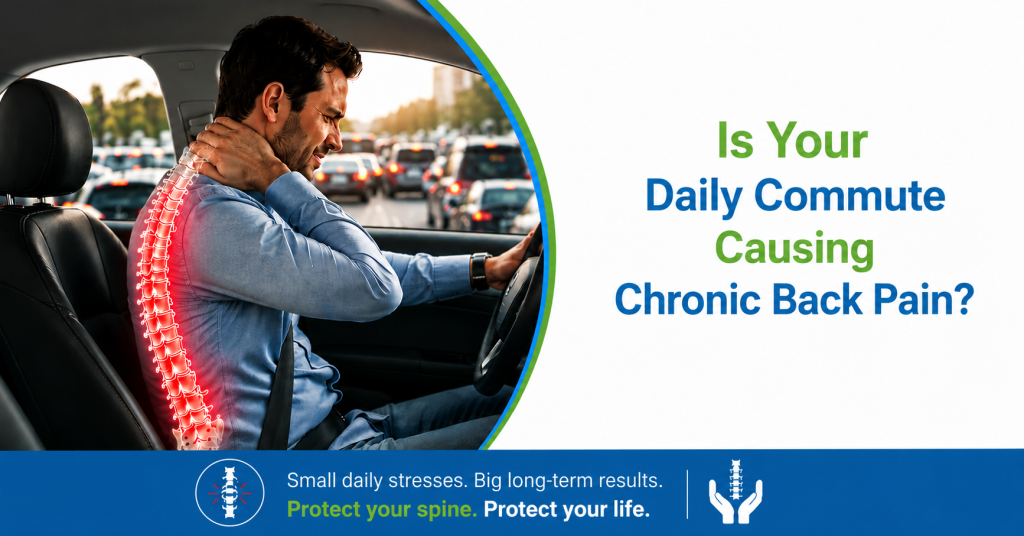
You spend 30, 45, maybe 60 minutes in the car each way, sitting in the same position, gripping the wheel, inching through traffic on I-75 or I-71. By the time you get home, your lower back feels tight, achy, or downright sore. Then it happens again the next day. And the next.
If that sounds familiar, your commute might be doing more damage to your spine than you realize. At Meade Chiropractic, we see this pattern often in patients from Florence, Highland Heights, and across the Northern Kentucky and Greater Cincinnati area, people who never had back problems until their daily drive became a daily routine. Let’s look at why this happens, how to recognize it, and what you can actually do about it.
How Your Daily Commute Affects Your Spine
Driving feels passive, but your spine is working the whole time. A few specific factors make commuting uniquely hard on your back.
Prolonged Sitting Increases Disc Pressure
Sitting puts significantly more pressure on your spinal discs than standing or walking does. That pressure compresses the discs in your lower back, and the longer you sit without a break, the more that compression adds up. A 20-minute commute is manageable. An hour each way, five days a week, is a different story.
Vehicle Vibration Adds Micro-Stress to Your Spine
Every bump, pothole, and vibration from the road transfers through your seat and into your spine. Over time, this low-level jarring can irritate joints and soft tissue, especially in the lower back, even if you never notice it happening in the moment.
Poor Seat Ergonomics and Slouched Posture
Most car seats aren’t designed with spinal health in mind. Without proper lumbar support, your lower back tends to round outward, flattening its natural curve. That slouched position, held for long stretches, puts extra strain on the muscles and ligaments that support your spine.
Gripping the Wheel and Upper Body Tension
Traffic stress doesn’t stay in your head. Clenched hands on the wheel, hunched shoulders, and a tense jaw often carry straight down into your upper back and neck, and can even contribute to tension that radiates lower.
Signs Your Commute Might Be the Cause of Your Back Pain
Not sure if your car is really the culprit? A few patterns are worth paying attention to:
- Your back feels fine on weekends or days you don’t drive, but flares up after commute days.
- Pain builds gradually during the drive and peaks toward the end.
- Stiffness is worse on one side, often the side you lean toward while driving.
- You feel relief almost immediately after standing up and walking around.
- Pain seems to compound throughout the work week and eases over a day or two off.
Who’s Most at Risk
Some people are more vulnerable to commute-related back pain than others:
- Long-distance commuters driving 45 minutes or more each way
- Rideshare and delivery drivers who spend most of their workday behind the wheel
- Desk workers who also drive long commutes, doubling their daily sitting time
- Anyone with an existing spinal issue, like a herniated disc or degenerative disc disease, since sitting tends to aggravate these conditions further
Common Mistakes People Make Behind the Wheel
A lot of commute-related back pain comes down to small, fixable habits.
- Sitting too close or too far from the pedals, forcing an awkward hip and knee angle
- Skipping lumbar support, letting the lower back round for the entire drive
- Sitting on a wallet or phone, which subtly tilts the pelvis out of alignment
- Twisting to check mirrors that haven’t been properly adjusted
- Never taking breaks on longer drives, even though a short stretch every hour makes a real difference
- Slouching at red lights, assuming it doesn’t count because the car isn’t moving
Practical Tips to Protect Your Back During Your Commute
Adjust Your Seat and Mirrors Properly
Your knees should sit slightly lower than your hips, and you shouldn’t have to lean forward to reach the pedals or wheel. Adjust your mirrors before you start driving, not while you’re on the road twisting to see around a blind spot.
Use Lumbar Support
A small lumbar cushion or rolled towel placed at the curve of your lower back can help maintain your spine’s natural alignment, especially on longer drives.
Take Micro-Breaks and Stretch
On longer commutes, a quick stop to stand, walk, and stretch every hour or so gives your spinal discs a break from constant compression. Even a two-minute stretch can help.
Watch Your Posture at Red Lights and in Traffic
Use moments stopped in traffic to check in with your posture. Roll your shoulders back, unclench your jaw, and reset your grip on the wheel. Small resets throughout the drive add up.
When Commute-Related Back Pain Signals Something More Serious
Everyday stiffness from sitting is one thing. Some symptoms deserve closer attention:
- Pain that radiates down one leg, which can point to sciatica
- Numbness or tingling in your legs or feet
- Back pain that started or worsened after a fender bender or car accident, which can indicate whiplash or another injury even if symptoms didn’t show up right away
- Pain that doesn’t improve with rest, movement, or over-the-counter relief
- Pain that’s getting progressively worse week over week rather than staying steady
If any of these sound familiar, it’s worth getting evaluated rather than waiting for it to resolve on its own.
How Chiropractic Care Can Help Commuters
The good news is that commute-related back pain is one of the most treatable types of chronic back pain, because the cause is usually mechanical and identifiable. At Meade Chiropractic, we start by figuring out exactly what’s driving your pain, whether it’s spinal misalignment from prolonged sitting, disc compression, or muscular imbalance from posture habits behind the wheel.
Treatment often combines spinal manipulation to restore proper alignment and joint mobility, along with low back pain relief techniques targeted at the specific area affected by your driving posture. For patients whose back pain traces back to posture habits, ongoing posture exercises and stretches can help retrain the muscles that support your spine day to day. And if your pain began after a car accident, our personal injury and whiplash treatment options address injuries that standard rest alone often won’t resolve.
We work with commuters throughout Florence KY, Highland Heights KY, Erlanger, Cold Spring, Alexandria, and the broader Boone County and Greater Cincinnati area, many of whom didn’t realize how much their daily drive was contributing to their pain until we walked through it together.
Frequently Asked Questions
Can sitting in traffic actually cause back pain?
Yes. Prolonged sitting increases pressure on spinal discs, and traffic-related stress often adds muscle tension on top of that, making the combination particularly hard on your back.
How long of a commute is considered risky for back health?
There’s no strict cutoff, but commutes over 30–45 minutes each way, especially without breaks or proper seat support, are more strongly associated with chronic back pain.
Should I see a chiropractor if my back only hurts after driving?
Yes, especially if the pattern is consistent. A chiropractor can identify whether it’s a posture issue, disc issue, or alignment issue, and address the root cause rather than just the symptom.
Can a better car seat or cushion really make a difference?
Absolutely. Proper lumbar support can significantly reduce the strain on your lower back during long periods of sitting, particularly when combined with correct seat positioning.
What should I do if my back pain started after a minor car accident?
Even minor accidents can cause whiplash or spinal misalignment that isn’t immediately obvious. It’s worth getting checked out, since these injuries can worsen if left untreated.
Contact Meade Chiropractic
Florence KY Chiropractic Office
Call: 859-640-6770
Highland Heights KY Chiropractic Office
Call: 859-441-8181
Final Thoughts
Your daily commute might feel like an unavoidable part of life, but the back pain that comes with it doesn’t have to be. Once you understand how sitting, vibration, posture, and stress combine to strain your spine, small adjustments, from seat positioning to stretch breaks, can make a real difference.
If commute-related back pain has become part of your routine, Meade Chiropractic can help you pinpoint the actual cause and build a plan to fix it. Reach out to our Florence KY or Highland Heights KY office to schedule an evaluation and get your commute working for you instead of against you.
Summary
Yes, daily commuting can cause chronic back pain due to prolonged sitting, disc compression, vehicle vibration, and poor seat posture. Long commutes without lumbar support or movement breaks increase strain on the lower back. Proper seat ergonomics, stretching, and chiropractic care can help prevent and relieve commute-related back pain.