

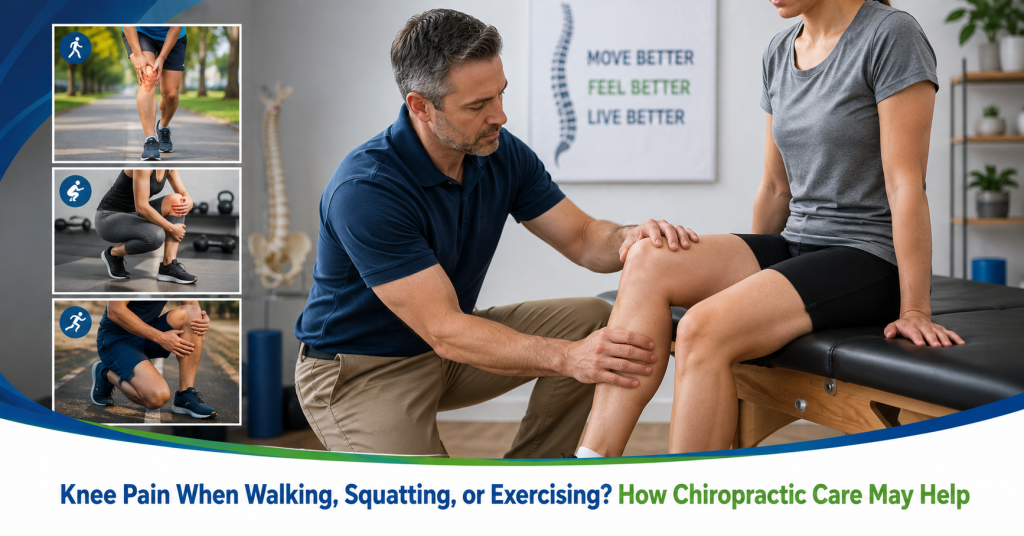
Knee pain when walking and squatting has a way of showing up right when you’re trying to stay active, mid-walk, halfway through a workout, or the moment you bend down. It’s frustrating, and it’s easy to assume it’s just “wear and tear” you have to live with. At Meade Chiropractic, this is one of the most common movement-related complaints we see, and in a lot of cases, it’s more fixable than people expect once the actual cause is identified.
Let’s look at why certain movements seem to trigger knee pain specifically and how chiropractic care can help address it.
Why Knee Pain Shows Up During Specific Movements
Pain that appears only during certain activities, rather than constantly, is actually a helpful clue. It suggests the issue is mechanical, tied to how your knee moves and bears weight during that specific motion, rather than something like an infection or systemic condition. Understanding what’s happening in your knee during walking, squatting, and exercise is the first step toward figuring out what’s actually going on.
What’s Happening in Your Knee During Walking, Squatting, and Exercise
Walking: Repetitive Impact and Alignment
Walking involves thousands of repetitive impacts on your knee joint over the course of a day. If your alignment, from your hips down to your ankles, isn’t quite right, that repetition can gradually irritate the joint, even though each individual step feels minor on its own.
Squatting: Deep Flexion and Joint Loading
Squatting places your knee in deep flexion, which increases the load moving through the joint and surrounding tendons. If your hips or ankles have limited mobility, your knee often has to compensate for that restriction, absorbing more stress than it should during the movement.
Exercising: Repetitive Stress and Muscle Imbalance
Exercise, particularly running, jumping, or repetitive lower-body movements, combines both impact and load. Muscle imbalances around the hip and thigh can pull the kneecap slightly out of its ideal tracking position, which often becomes noticeable specifically during exercise rather than at rest.
Common Underlying Causes Behind Activity-Triggered Knee Pain
- Patellar tracking issues, where the kneecap doesn’t move smoothly within its groove during bending motions
- IT band tightness, which pulls on the outer knee during repetitive movement like walking or running
- Limited hip or ankle mobility, forcing the knee to compensate during squatting or exercise
- Muscle imbalances, particularly weak hip stabilizers, that affect how the knee tracks during movement
- Gait abnormalities, often stemming from spinal or pelvic misalignment, that place uneven stress on the knee with every step
- Overuse without adequate recovery, especially in people who’ve recently increased activity level
How Chiropractic Care Addresses Knee Pain From Movement
Correcting Hip and Ankle Alignment
Since the knee depends heavily on proper alignment above and below it, correcting hip and ankle positioning through chiropractic care often reduces the compensation patterns contributing to knee pain during walking and squatting.
Extremity Adjustments for the Knee Itself
Through manipulation of the spine and extremities, a chiropractor can directly address restrictions within the knee joint, improving mobility and reducing the strain that builds up during repetitive activities like walking or exercise.
Restoring Balanced Muscle Function
Chiropractic care, often combined with targeted strengthening guidance, helps correct the muscle imbalances that pull the kneecap out of alignment, addressing one of the most common causes of exercise-related knee pain, a topic we’ve also covered in more detail in our post on chiropractic care for knee pain and mobility.
Common Mistakes People Make With Activity-Related Knee Pain
- Pushing through pain during exercise. Continuing high-impact activity on a mechanically compromised knee often worsens the underlying issue.
- Only stretching the knee itself. Since the root cause is frequently in the hip or ankle, focusing exclusively on the knee misses the actual problem.
- Assuming it’s simply age-related wear. While age plays a role for some, many cases of activity-triggered knee pain stem from correctable alignment or muscle imbalances.
- Skipping a proper warm-up. Cold, stiff joints and muscles are more prone to strain during squatting or exercise.
- Ignoring gait or movement pattern issues. Without addressing how you walk or move, knee pain often returns even after temporary relief.
Practical Tips to Reduce Knee Pain During Walking, Squatting, and Exercise
- Strengthen hip stabilizer muscles to improve knee tracking during movement
- Work on hip and ankle mobility to reduce compensation at the knee
- Warm up properly before squatting or exercising to prepare joints and muscles for load
- Pay attention to footwear, since poor support can affect alignment throughout the leg
- Avoid rapidly increasing activity intensity without allowing your body to adapt gradually
When to See a Chiropractor for Knee Pain
If knee pain consistently shows up during the same activities, walking, squatting, or specific exercises, and hasn’t improved with rest or basic stretching, it’s worth having your hips, ankles, and gait evaluated alongside the knee itself. Addressing only the knee while missing a hip or ankle-related cause rarely leads to lasting relief.
Serving Erlanger, Union, Elsmere & Burlington
Dr. Brandon Meade provides chiropractic care for activity-related knee pain to patients throughout Erlanger, Union, and Elsmere, KY, along with Burlington and the broader Boone County area, helping active individuals move, walk, and exercise without the nagging knee pain that so often traces back to a correctable alignment issue.
Frequently Asked Questions
Why does my knee only hurt when I’m walking or squatting, not all the time?
Pain that’s specific to certain movements usually points to a mechanical cause, like a hip, ankle, or alignment issue, rather than something affecting the knee constantly.
Can weak hip muscles really cause knee pain during exercise?
Yes. Weak hip stabilizers can allow the kneecap to shift out of its ideal tracking position during movement, which often becomes noticeable specifically during exercise or squatting.
Is chiropractic care effective for knee pain caused by running?
Yes, particularly when the pain stems from gait compensation, muscle imbalance, or hip and ankle alignment issues, all of which chiropractic care can help address.
Should I stop exercising if my knee hurts during squats?
It’s generally wise to reduce or modify activity that consistently triggers pain until the underlying cause is evaluated, rather than pushing through it repeatedly.
Can chiropractic adjustments improve squat depth and knee comfort?
Yes. Improving hip and ankle mobility, along with correcting knee joint restrictions, can reduce compensation and discomfort during deep movements like squatting.
How long does it take to notice improvement in activity-related knee pain?
This varies by individual, but many patients notice reduced discomfort within a few weeks of addressing the underlying alignment and mobility issues.
Contact Meade Chiropractic
Florence, KY Chiropractic Office
Call: 859-640-6770
Highland Heights, KY Chiropractic Office
Call: 859-441-8181
Final Thoughts
Knee pain when walking and squatting isn’t something you have to just push through or accept as inevitable. Because these activities put the knee’s alignment, mobility, and surrounding muscle balance to the test, pain that shows up specifically during movement is often a clear, correctable signal rather than a mystery.
If knee pain has been interrupting your walks, workouts, or daily movement, understanding what’s actually happening in the joint is the first step toward getting back to moving comfortably.
Summary
Knee pain during walking, squatting, or exercising often stems from hip or ankle misalignment, muscle imbalance, or patellar tracking issues rather than the knee itself. Chiropractic care addresses this through spinal and extremity adjustments, restoring proper alignment and reducing the compensation patterns causing activity-related knee pain.